The End of Call Centers as We Know Them: How AI Voice Agents Will Reshape 2025–2028
Updated
TL;DR, Labor drives most contact-center costs, customers still turn to the phone for serious issues, and AI voice agents are finally good enough to handle a growing share of calls. The new model: an AI call agent handles volume instantly; human experts take the edge cases. Move early, and you bank efficiency and higher CSAT.Why the legacy model is breaking
- Labor dominates the P&L. Gartner notes that labor can represent up to 95% of contact-center costs,so automating the repeatable tier-1 work has an outsized impact. (nice.com)
- Each call is expensive. Benchmarks put average cost per call at $2.70–$5.60 across industries; at scale, shaving even 30–60 seconds is real money. (sprinklr.com)
- Turnover bleeds performance. Contact centers routinely face 30–45% annual attrition, driving constant hiring/training cycles. (Nextiva)
Why voice still matters (even for Gen Z)
Despite the rise of chat, a 2024 McKinsey survey found live phone calls remain among the most preferred channels for support, including with 18–28 year-olds. If the phone stays, make it instant,with an AI agent that answers right away and escalates cleanly when needed. (McKinsey & Company)Market signals you can’t ignore
Gartner projects that by 2026, conversational AI will reduce agent labor costs by $80B and that 1 in 10 agent interactions will be automated. That’s not sci-fi,that’s budget planning territory. (Zawya)NLPearl’s adoption projection (to make the change tangible)
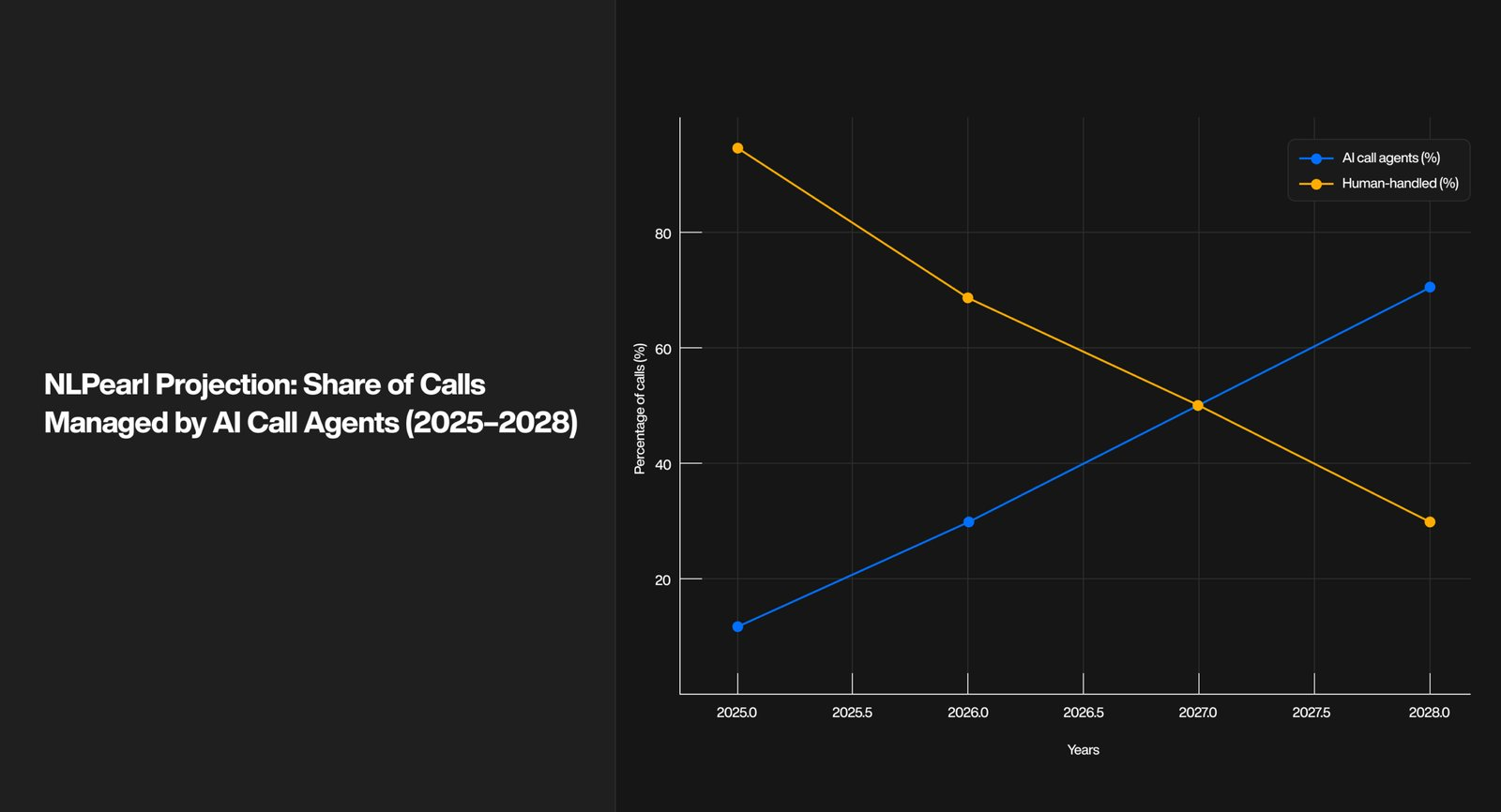
- 2025: 5% of calls handled by an AI call agent (pilots & early adopters)
- 2026: 30% (standardization across e-commerce, hospitality, banking, utilities, telecom)
- 2027: 50% (mass adoption in insurance, healthcare, transport, local government)
- 2028: 70% (humans focus on ultra-complex/sensitive cases)
What a winning transition looks like (playbook)
- Start with the top 5–10 intents (status, FAQs, scheduling, payments, password resets). Route them first to the AI voice agent; keep a clean human handoff with auto-summaries into your CRM.
- Optimize for zero wait. Instant pickup + interruption handling + escalation when confidence dips.
- Measure weekly: AHT, FCR, CSAT, cost/call, escalation rates.
- Tighten governance: anonymization, data retention, jurisdictional compliance (e.g., GDPR/HIPAA by sector).
- Iterate continuously: review transcripts, enrich knowledge, tune prompts/guardrails, A/B test voices and persona.
- Upskill humans: move agents to higher-value tasks,saves cost and improves retention.
The ROI math (simple and CFO-friendly)
If your baseline is $2.70–$5.60 per call, shifting a meaningful slice of volume to an AI agent (with faster handling and fewer transfers) compounds savings quickly,and usually improves CSAT thanks to zero hold time. Plug your numbers into: Savings ≈ (Calls shifted × (Human CPC − AI CPC)) − Platform costs. Benchmark the result against your 90-day pilot. (sprinklr.com)Beyond Automation: The Human Question in the Age of AI Call Agents
As AI voice agents take over the noise, waiting lines, repetitive FAQs, identity checks, they push human labor toward the edge cases: judgment, empathy, accountability. Efficiency, however, is never neutral. It turns immediacy into a social norm, standardizes the voice (accents, emotions), and enforces an algorithmic triage of attention, who “deserves” a human, who is left to a machine. Done well, this delegation restores dignity to service (fewer absurd scripts, more focus on complex needs) and expands accessibility (24/7, multilingual). Done poorly, it produces invisibility for the vulnerable, perpetual surveillance, and an impoverishment of human contact. The core issue is not “AI or human,” but the ethics of attention: who writes the rules, how they are audited, and whether the right to “speak to someone” remains sacred. The real question is not if AI replaces us, but what kind of humans we choose to be when it frees us from the noise.Ready to see it live?
Spin up an AI call agent with NLPearl on your top intents, measure the before/after, and keep it only if the numbers prove out. 👉 Try Pearl on a sandbox line or your IVR this week.- 15-minute scoping → choose intents
- 2-week pilot → real traffic, real KPIs
- Keep it if it beats your baseline
Sources
- Labor as dominant cost driver (Gartner quote, via NICE): labor can be up to 95% of contact-center costs. (nice.com)
- Cost per call benchmarks $2.70–$5.60. (sprinklr.com)
- Turnover 30–45% typical. (Nextiva)
- Phone remains a preferred support channel, even for Gen Z. (McKinsey & Company)
- Gartner: $80B labor-cost reduction & 1 in 10 interactions automated by 2026. (Zawya)