EU AI Act Article 50 Is Now in Force: What It Means for AI Voice Agents, Chatbots and Synthetic Voices
On August 2, 2026, a simple rule became enforceable across the European Union: when an AI system talks to a person, that person has to know it is an AI. The rule lives in Article 50 of the EU AI Act, and it covers every chatbot, virtual assistant and AI voice agent that interacts with people in the EU, wherever the company behind it is based.
Many teams expected a reprieve. In July, the EU adopted the Digital Omnibus on AI, which pushed the Act's high-risk obligations back to December 2027. Article 50 was left out of that delay. The only relief is a short grace period, until December 2, 2026, for the machine-readable marking of AI-generated content by systems that were already on the market. Everything else is live today, backed by fines of up to €15 million or 3% of worldwide annual turnover.
For anyone running conversational AI in customer experience, this is the most practical AI regulation so far. It does not ask you to classify risk or file a conformity assessment. It asks one question about every call and every chat: did the person know they were talking to an AI?
This guide explains what Article 50 requires, why AI voice agents sit at the center of it, who is responsible for what, and how to design disclosure that protects compliance and customer experience at the same time. It also covers the parallel rules in the United States and ends with a practical readiness checklist.
This article is for general information and does not constitute legal advice.
What Article 50 of the EU AI Act Actually Requires
Article 50 sets four transparency duties. Two fall on providers, the companies that build an AI system and place it on the market under their own name. Two fall on deployers, the businesses that use an AI system under their own authority. Unlike most of the AI Act, none of them depend on whether a system is classified as high-risk.
The four transparency duties at a glance
Duty | Article | Who is responsible | What it means in practice |
|---|---|---|---|
Tell people they are interacting with AI | 50(1) | Provider | Systems that talk directly with people, such as chatbots, AI agents and voice assistants, must be designed so users are informed they are dealing with AI, unless that is obvious. |
Mark AI-generated content | 50(2) | Provider | Synthetic audio, images, video and text must carry machine-readable marks so they can be detected as AI-generated or manipulated. |
Inform people about emotion recognition or biometric categorization | 50(3) | Deployer | Anyone exposed to these systems must be told they are in operation. |
Label deepfakes and certain AI-generated text | 50(4) | Deployer | Deepfake audio, images or video must be disclosed, and AI-generated text published to inform the public on matters of public interest must be labeled unless it went through human review or editorial control. |
Article 50(5) then sets the standard for how information is delivered: in a clear and distinguishable way, at the latest at the first interaction or exposure, and in line with accessibility requirements. The European Commission's Article 50 FAQ is explicit that people must be notified from the start of the first interaction.
Why the Digital Omnibus did not delay Article 50
The transparency duties attach to what a system does (converse, generate, recognize emotions, produce deepfakes), not to a risk tier. That is why the Digital Omnibus on AI, Regulation (EU) 2026/1744, could postpone the high-risk regime without touching them. It entered into force on July 27, 2026, moved stand-alone high-risk systems to December 2, 2027 and high-risk AI embedded in regulated products to August 2, 2028, and left the Article 50 start date in place. As law firm Jones Walker put it in its analysis of the Omnibus, the high-risk delay should not be mistaken for a general postponement of Article 50.
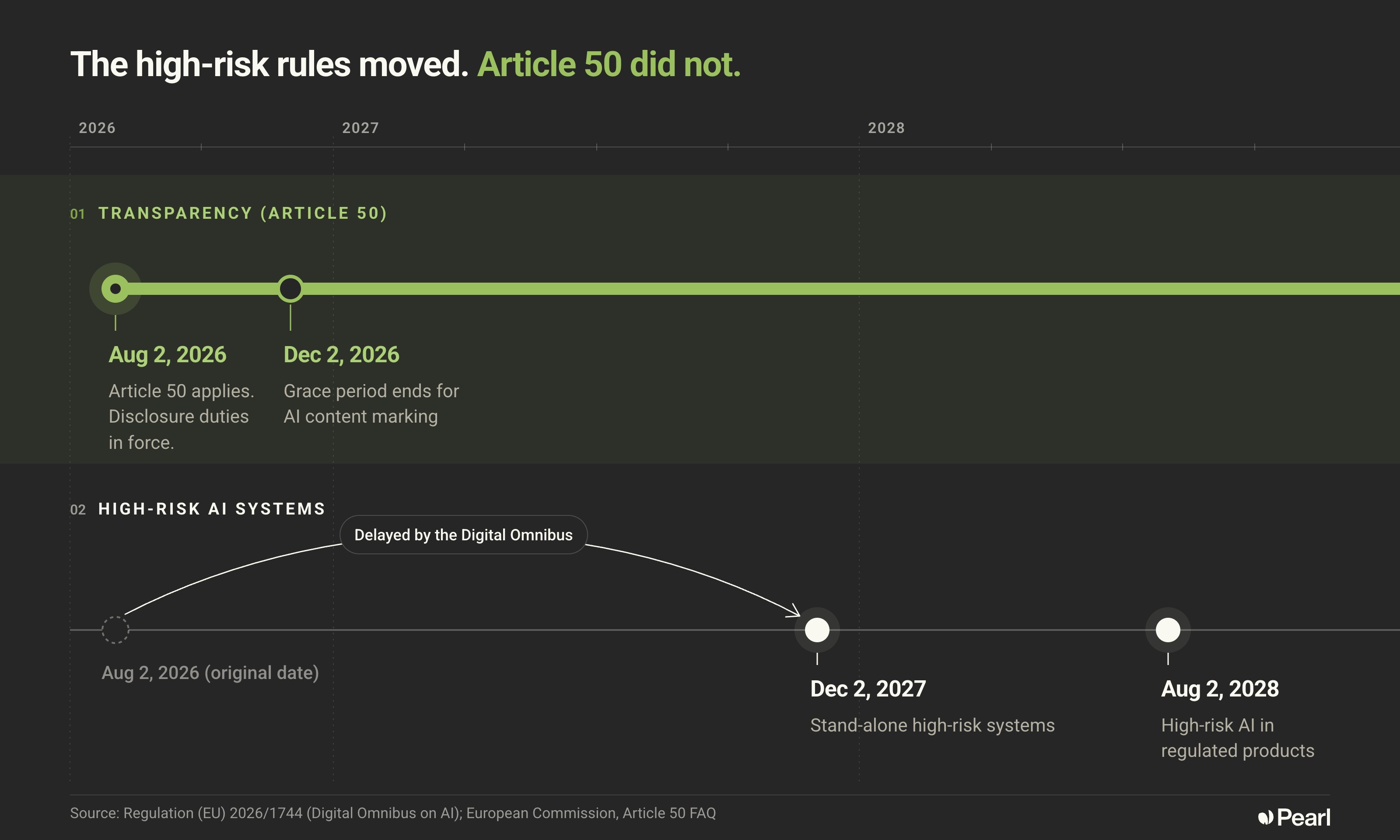
Key dates for Article 50 and the wider AI Act
Date | Milestone |
|---|---|
July 20, 2026 | The Commission adopts its guidelines on Article 50 transparency obligations |
July 27, 2026 | The Digital Omnibus on AI enters into force |
July 31, 2026 | The EU AI Office publishes the voluntary Code of Practice on Transparency of AI-Generated Content |
August 2, 2026 | Article 50 applies and becomes enforceable |
December 2, 2026 | Grace period ends for Article 50(2) marking by generative systems placed on the market before August 2, 2026 |
December 2, 2027 | Obligations for stand-alone high-risk AI systems (Annex III) apply |
August 2, 2028 | Obligations for high-risk AI embedded in regulated products (Annex I) apply |
Who enforces Article 50, and how large are the fines?
Enforcement sits mainly with national market surveillance authorities. The EU AI Office has a narrower role, covering systems built on general-purpose AI models when the same company provides both the model and the system. Fines for breaching Article 50 can reach €15 million or 3% of total worldwide turnover for the preceding financial year, with proportionality considered for SMEs and small mid-caps.
Geography offers no shelter. The Act applies to providers established outside the EU whenever the output of their AI system is used in the EU. A US or Israeli company whose voice agent calls customers in Germany is in scope.
Why AI Voice Agents Are at the Center of Article 50
AI voice agents touch more of Article 50 than any other form of conversational AI. They interact directly with people, which triggers the disclosure duty. They generate synthetic speech, which brings in the marking duty. And when they speak with a cloned voice, they can produce deepfake audio. A text chatbot usually meets one of these conditions. A modern AI phone agent can meet all three in a single call.
An AI phone call meets every criterion of an "AI interaction"
The Commission's guidelines set out four cumulative criteria for the disclosure duty in Article 50(1). The system must qualify as an AI system, it must be designed for a genuine two-way exchange, the interaction must be direct rather than through a human intermediary, and the other party must be a natural person.
A generative AI voice agent that answers a call, understands the caller and responds in its own words ticks every box. Systems that run only in the background, talk machine to machine, or merely collect data without a real exchange fall outside the duty. A traditional press-1 menu may sit on that side of the line. A conversational voice agent does not.
The more human the voice, the weaker the "obvious" exception
Article 50(1) does not apply when it is obvious that someone is talking to an AI. The Commission tells providers to judge this from the point of view of a reasonably well-informed, observant and circumspect person, and to read the exception restrictively because it takes transparency away from people.
Here lies the paradox of voice AI in 2026. The industry has spent years removing everything that made machines sound like machines: the long pauses, the flat intonation, the inability to handle an interruption. Full-duplex, low-latency speech-to-speech models now take turns, react mid-sentence and sound natural. Every one of those gains makes it less obvious that the caller is speaking with an AI. For a natural-sounding voice agent on a phone line, the safe working assumption is simple: the exception does not apply, and every call needs a disclosure.
Synthetic speech and the marking obligation
Article 50(2) requires providers of AI systems that generate synthetic audio to mark those outputs in a machine-readable format so they can be detected as AI-generated. This is a provider duty, relevant to text-to-speech vendors and voice agent platforms rather than to the businesses that deploy them.
Three details matter. Generative systems already on the market before August 2, 2026 have until December 2, 2026 to comply with marking. Outputs exchanged only machine to machine, with no human exposure, are out of scope. And providers can rely on the voluntary Code of Practice on Transparency of AI-Generated Content to demonstrate compliance in a predictable way. If you deploy a voice agent, ask your vendor how it addresses marking before December.
Voice cloning and deepfake audio
The AI Act defines a deepfake as AI-generated or manipulated audio, image or video that resembles existing persons, objects, places or events and would falsely appear authentic. For audio, three conditions must all be met: a high level of resemblance, a real or plausible subject, and a false appearance of authenticity.
A voice agent that speaks in the cloned voice of a real employee, founder or public figure, and is presented as that person, can meet all three. The deployer must then disclose it clearly at first exposure, in a way people can perceive without any tools, such as an audible statement. The Commission is explicit that a machine-readable watermark embedded by the provider does not satisfy this duty on its own. Cloning a real voice also raises separate consent and data protection questions under the GDPR.
A note on emotion recognition in voice analytics
If your analytics infer callers' emotions from their voice, check whether the feature qualifies as an emotion recognition system under the Act, a category defined by its use of biometric data. If it does, Article 50(3) requires you to inform the people exposed to it, and Article 5 already prohibits emotion recognition in workplaces and educational institutions outside narrow medical and safety exceptions.
Provider or Deployer? Who Is Responsible for What
In most customer experience deployments, Article 50 responsibility is shared. The company that builds the AI system is the provider, the business that runs it with its own customers is the deployer, and a growing number of companies are both.
Your situation | Likely role | Main Article 50 duties |
|---|---|---|
You build and sell a voice agent platform, a chatbot platform or a TTS model | Provider | Design systems so people are informed they are talking to AI (50(1)); mark synthetic audio, video, images and text in a machine-readable way (50(2)) |
You configure an AI agent on a vendor's platform and run it with your own customers | Deployer | Disclose deepfakes, for example a cloned real voice presented as that person (50(4)); inform people about emotion recognition (50(3)) |
You build your own agent in-house and put it into service under your brand | Provider and deployer | All of the above |
The line can blur. The Act defines a provider as anyone who develops an AI system, or has it developed, and places it on the market or puts it into service under their own name or trademark. A business that assembles its own branded agent on top of a platform may therefore carry provider duties for that agent. The Commission also notes that a company stays the deployer even when contractors or freelancers operate the system on its behalf.
Two practical conclusions follow. First, write the split of duties into your vendor contracts, including who delivers the disclosure and who handles marking. Second, whatever your role, treat the disclosure itself as a fixed part of the agent, not a setting someone can forget.
How to Disclose AI on a Phone Call and in Chat
The most reliable way to meet Article 50(1) on a phone line is also the simplest: a short, plain disclosure in the very first sentence the agent speaks, in the caller's language, before anything else happens. The details below turn that principle into design decisions.
Put the disclosure in the first sentence
Article 50 requires the information to reach people at the first interaction, in a clear and distinguishable way that respects accessibility. On a call, that rules out a disclosure that is whispered, sped up, buried after a long greeting or hidden in hold music. Use the words "AI" or "artificial intelligence". Terms like "virtual agent" or "digital colleague" leave room for doubt, and doubt is what the rule is designed to remove.
Good disclosures are short and do not slow the call down. A few examples, using a fictional company:
Inbound support: "Hi, you've reached Northwind Insurance. I'm Ava, Northwind's AI assistant. How can I help you today?"
Outbound renewal: "Hello, this is Leo, an AI assistant calling on behalf of Northwind Energy about your contract renewal. Is now a good time?"
French: "Bonjour, vous êtes en ligne avec Emma, l'assistante IA de Northwind. Comment puis-je vous aider ?"
German: "Guten Tag, hier spricht Lena, die KI-Assistentin von Northwind. Wie kann ich Ihnen helfen?"
Spanish: "Hola, soy Sofía, la asistente de inteligencia artificial de Northwind. ¿En qué puedo ayudarle?"
A name and a personality are fine. A persona that implies a human, such as "I'm Sarah from the billing team" with no mention of AI, is not.
Never leave disclosure to the model's judgment
The most common way to get this wrong is to write "always tell the caller you are an AI" into the agent's prompt and consider it done. A prompt instruction is a strong suggestion to a probabilistic model, not a guarantee. It can be skipped when the caller speaks first, when they interrupt with an urgent question, when the conversation switches language, or when a call is handed from one agent to another.
Across the production voice agents we have built and analyzed at NLPearl, one root cause stands out behind agent failures: a mandatory action left to the agent's judgment. Disclosure is the definition of a mandatory action. It belongs in a fixed, scripted step that runs on every call, not in the list of things the model should try to remember. Two edge cases deserve explicit handling: callers who talk over the opening line, where the disclosure should complete or be repeated, and outbound calls that reach voicemail.
Answer honestly when someone asks "Am I talking to a robot?"
People will ask, often mid-call and often bluntly. The agent should confirm plainly that it is an AI and, where a human team is available, offer to transfer the call. Denying or dodging the question turns a compliance obligation into a trust problem.
Keep evidence for every conversation
If a regulator, an auditor or an unhappy customer asks whether a given call included the disclosure, "our prompt says so" is not an answer. Recordings and transcripts are. Keep them in line with your data retention policy, and regularly review a sample across languages, campaigns and agent versions to confirm the disclosure is actually delivered.
Text channels: SMS, WhatsApp, email and web chat
The same logic applies to AI text agents. Disclose in the first message, in plain words, and keep the agent's name or label consistent with that disclosure. A small "AI" badge in a chat widget may help, but a first-message disclosure is the approach least likely to be challenged.
Beyond Europe: AI Disclosure Is Becoming the Global Default
The EU is the first jurisdiction to turn AI disclosure into a horizontal legal duty, but it is not alone in regulating how AI talks to people. In the United States, the rules that matter most for voice and chat agents already exist, and they point in the same direction.
The FCC and AI-generated voices on phone calls
In February 2024, the Federal Communications Commission ruled unanimously that AI-generated voices count as "artificial" under the Telephone Consumer Protection Act (TCPA). In practice, the TCPA's rules for artificial or prerecorded voice calls, including the requirement for prior express consent, apply to outbound calls placed with an AI voice. The FCC also made clear that there is no carve-out for technologies that claim to be the equivalent of a live agent. For outbound AI calling in the US, consent management matters as much as the conversation itself.
California's bot disclosure law
California's Business and Professions Code section 17941 makes it unlawful to use a bot online to mislead people about its artificial identity in order to drive a sale or influence a vote. A clear, conspicuous disclosure that the bot is a bot removes that liability. The law targets online interactions such as web chat and messaging, which makes it directly relevant to AI text agents.
One disclosure standard for every market
For companies running AI agents across several countries, the most efficient approach is to design once to the strictest standard and apply it everywhere. An agent that discloses in its first sentence, in the customer's language, and answers honestly when asked, meets the EU rule and the spirit of the US rules at the same time. It also gives customers the same experience of your brand wherever they call from.
Does AI Disclosure Hurt Customer Experience?
Not when the agent is good. What damages customer experience is deception and dead ends, not the word "AI" in a greeting. A caller who learns halfway through, or afterwards, that the friendly voice was a machine feels misled. A caller told upfront, then helped quickly, simply gets on with it.
The stakes are rising fast. Gartner predicts that by 2029, agentic AI will autonomously resolve 80% of common customer service issues without human intervention, cutting operational costs by 30%. When most routine conversations are handled by AI, trust stops being a brand value and becomes infrastructure. Disclosure is its first layer.
Article 50 also changes the competitive landscape for AI in customer service. Once every agent in Europe introduces itself as an AI, sounding human is no longer the differentiator it used to be. What customers will notice is everything that follows the first sentence: how fast the agent responds, whether it understands an interruption, whether it can actually book the appointment, update the order or process the request, and whether it knows when to hand over to a person. Disclosure levels the field. Quality decides who wins on it.
How NLPearl Approaches Transparency in AI Voice and Text Agents
At NLPearl, we build AI voice and text agents that handle real sales, support and operational conversations, inbound and outbound, at scale. Article 50 lines up with principles we already design around: an agent earns trust through what it does reliably on every call, and that trust should be backed by evidence rather than assumed.
We build the core of our voice stack ourselves
Our AI voice agents run on a proprietary speech-to-speech architecture that delivers natural, low-latency, full-duplex conversations in 20+ languages. We also build Pearl TTS v2, our own text-to-speech model, with voices managed in Voice Studio. Building the core of the stack in-house means we know exactly where synthetic speech is produced in a conversation, and it lets a disclosure sound as natural in German or Hebrew as it does in English.
The opening sentence is a fixed step, not a suggestion
Every voice agent on NLPearl, which we call a Pearl, is built as a conversation flow that starts with a dedicated opening sentence. That is where an AI disclosure belongs: delivered on every call, in the same way, before the model makes a single decision on its own. The same flow logic governs mandatory steps later in the call, so critical actions do not depend on the agent's judgment.
You do not need to code any of this. PearlVibe, our AI agent engineer, builds agents from a conversation: you describe the business, the tone and the rules, including how the agent should introduce itself in each language, and PearlVibe configures the flow, the knowledge base and the integrations. Teams that prefer to work programmatically can build Pearl flows through the API or provision agents dynamically at scale with the same structure. PearlVibe can also read real calls and chats to show what the agent said and which flow steps ran, which makes it straightforward to confirm that the disclosure was delivered.
Evidence for every conversation
For every call, NLPearl provides post-call data: structured summaries, transcripts, recordings and extracted variables. Recording can be configured in the flow itself with a Recording node, and account security settings include audit logs, two-factor authentication and enterprise access controls. When someone asks whether a specific customer heard the disclosure, the answer is a transcript, not a promise.
A clear path to a human
Honest disclosure works best when the customer has somewhere to go. A Transfer Call node routes voice calls to your team when a caller asks for a person or a situation needs one. On messaging channels, Pearl Text keeps humans in the loop, with a Hand-Off node and the ability for your team to step into any conversation without breaking context.
One standard across voice and text
Pearl Voice and Pearl Text share customer context across phone, SMS, WhatsApp, email and web chat. That makes it natural to apply one disclosure standard everywhere a customer meets your AI, rather than one rule for calls and another for chat.
We see Article 50 as part of what it takes for AI agents to earn a permanent place in customer experience. It is also why the first line anyone reads on the NLPearl platform is a simple promise: AI agents you can trust.
Article 50 Readiness Checklist for AI Voice and Chat Agents
Use this checklist to bring an existing AI voice agent or chatbot in line with Article 50, or to design a new one correctly from day one.
Map every AI touchpoint. List every place where AI talks to people in the EU: inbound lines, outbound campaigns, web chat, SMS, WhatsApp and email.
Establish your role for each system. Decide whether you act as provider, deployer or both, and reflect the split of duties in your vendor contracts.
Script the disclosure. Write a short first-sentence disclosure for every language you serve, using the words "AI" or "artificial intelligence".
Make it deterministic. Deliver the disclosure as a fixed step of the conversation flow, not as a prompt instruction, and cover interruptions, voicemail and transfers between agents.
Prepare the honest answer. Define how the agent confirms it is an AI when asked, and where it transfers the conversation when a person is needed.
Audit your voices. Identify any cloned voice of a real person, confirm consent and usage rights, and add a deepfake disclosure where it is presented as that person.
Ask your vendors about marking. Confirm how your voice and TTS providers address machine-readable marking under Article 50(2), and whether they rely on the Code of Practice, before December 2, 2026.
Review your analytics. Check whether any feature infers emotions from biometric data such as voice, and inform people or remove it where required.
Keep the evidence. Retain recordings and transcripts in line with your retention policy, and review a sample regularly across languages and campaigns.
Re-check after every change. A new prompt, a new language or a new flow version can break a disclosure that used to work, so verify it before each release.
Frequently Asked Questions About Article 50 and AI Agents
What is Article 50 of the EU AI Act?
Article 50 of Regulation (EU) 2024/1689 sets transparency obligations for AI systems. Providers must ensure people know when they interact with AI and must mark AI-generated content. Deployers must disclose deepfakes, label certain AI-generated public-interest text and inform people about emotion recognition or biometric categorization.
When did Article 50 take effect?
Article 50 has applied and been enforceable since August 2, 2026. The only grace period covers machine-readable marking under Article 50(2) for generative systems placed on the market before that date, which must comply by December 2, 2026.
Do AI voice agents have to say they are AI in the EU?
Yes, in almost every case. An AI voice agent interacts directly with people, so its provider must design it so callers are informed they are talking to AI, from the start of the first interaction. The exception for cases where it is obvious is read restrictively and rarely fits a natural-sounding voice.
Does Article 50 apply to companies outside the EU?
Yes. The AI Act applies to providers established outside the EU whenever the output of their AI system is used in the EU. A company based in the United States or Israel that runs AI agents for customers in Europe is in scope.
Can a business rely on the "obvious" exception?
Only with great care. The test is whether a reasonably well-informed, observant and circumspect person would find it obvious that they are dealing with AI. For a human-sounding phone agent, that is very hard to argue, so a first-sentence disclosure is the safer choice.
Do AI-generated voices need to be watermarked?
Providers of AI systems that generate synthetic audio must mark outputs in a machine-readable format so they can be detected as AI-generated, subject to limited exceptions such as machine-to-machine outputs. Machine-readable marking does not replace an audible disclosure to the caller.
Is a cloned voice a deepfake under the AI Act?
It can be. Audio counts as a deepfake when it closely resembles a real or plausible person and would falsely appear authentic. A voice agent using a cloned real voice and presented as that person should be disclosed clearly at first exposure.
What are the penalties for breaching Article 50?
Fines can reach €15 million or 3% of total worldwide annual turnover for the preceding financial year, whichever is higher. National market surveillance authorities handle most enforcement, and proportionality is taken into account for SMEs and small mid-caps.
Does Article 50 apply to WhatsApp, SMS and web chat agents?
Yes. The disclosure duty covers any AI system designed for a genuine two-way exchange with people, whatever the channel. AI text agents on WhatsApp, SMS, email or web chat should disclose in their first message.
Did the Digital Omnibus delay Article 50?
No. The Digital Omnibus on AI postponed the high-risk obligations to December 2027 and August 2028, but left the Article 50 start date of August 2, 2026 in place, adding only the grace period for marking until December 2, 2026.
The First Sentence Is Now the Most Important Line in Your Call Flow
Article 50 does not slow down AI in customer experience. It settles the question every customer is entitled to ask and removes the temptation to blur the line between a person and a machine. From here, the companies that win with AI agents will be the ones whose agents introduce themselves honestly, then prove in the next two minutes that talking to an AI was the fastest way to get help.
That is the kind of agent we build at NLPearl: natural voice, real actions, human handoff when it matters, and a record of every conversation. If you are reviewing your AI voice or text agents for Article 50, or building your first one, start with the Getting Started guide, see how PearlVibe builds an agent from a single conversation, or create your first agent on the NLPearl platform.
Sources
European Commission, Transparency obligations under Article 50 of the AI Act (FAQ), last updated July 24, 2026
European Commission, Guidelines on transparency of AI-generated content
European Commission, Code of Practice on Transparency of AI-Generated Content
AI Act Service Desk, Article 50: Transparency obligations for providers and deployers of certain AI systems
EUR-Lex, Regulation (EU) 2024/1689 (Artificial Intelligence Act)
Baker Botts, EU AI Act Article 50 Transparency Obligations Go Live, September 2026
Jones Walker, Yes, August 2 Still Matters, July 2026
Federal Communications Commission, FCC Makes AI-Generated Voices in Robocalls Illegal, February 2024
California Legislative Information, Business and Professions Code section 17941
Gartner, Agentic AI Will Autonomously Resolve 80% of Common Customer Service Issues by 2029, March 2025