The FCC's New Opt-Out Rules Start November 25: What They Mean for AI Voice Agents
An AI agent calls to remind a customer that a payment is due. Halfway through, the customer says: "Stop calling me about this." Under the federal rule in force today, a US caller has to accept that request when it is made by any reasonable method, and is not allowed to dictate how people opt out. A 2024 rule that would have made the sentence stop every call needing the customer's consent was delayed and never took effect. On November 25, 2026, the FCC replaces it and loosens the first constraint: the caller may treat that sentence as stopping only payment reminders, and may tell people exactly how an opt-out has to be made.
The change comes from FCC Report and Order FCC 26-67, adopted on September 30, 2026 and published in the Federal Register on October 26 as 91 FR 67214. The order never mentions artificial intelligence. This piece looks at what it asks of a conversational AI agent that hears the request live.
The short answer
From November 25, the rule text changes two things for consent-based calls in the US, including calls placed by AI voice agents:
A revocation made on a purely informational call may be treated as covering only that category of calls. A revocation made on a call that contains an advertisement or telemarketing ends consent for all future telemarketing from that caller.
Callers may designate an exclusive opt-out method, disclosed on the call or in the text, and then do not have to process requests made any other way. Callers that designate nothing must keep accepting requests made by any reasonable means.
Two things stay as they are: valid requests must be honored within a reasonable time, ten business days at most, and artificial-voice calls that carry telemarketing (or rely on certain exemptions) keep their existing duty to offer an automated opt-out that ends the call.
For teams running AI agents, our reading is that this calls for four design decisions: when to rely on free-form recognition, how to label the category of every call, how to keep informational calls free of sales content, and how to move a revocation to every system that can contact the person. The rest of the article explains each. It describes the regulations; it is not legal advice.
Why the rules apply to AI agents at all
The new order does not mention artificial intelligence, and it does not need to: an earlier ruling covers the point. In February 2024, in declaratory ruling FCC 24-17, the Commission confirmed that the TCPA's restrictions on "artificial or prerecorded voice" calls cover current AI technologies that generate human voices. A call placed by an AI voice agent is therefore a robocall in the TCPA's sense. To wireless numbers and the other lines the TCPA protects, it needs prior express consent unless an emergency purpose or an exemption applies, and prior express written consent when it introduces an advertisement or constitutes telemarketing. The rules about revoking that consent apply to it.
What changes on November 25
The amended text of 47 CFR 64.1200(a)(10) and (a)(11), printed at the end of the Federal Register notice (the online eCFR will show it once it takes effect), does three things.
Revocations on informational calls can be scoped. If a person revokes consent in response to an informational call (one with no advertising or telemarketing), the caller may treat the request as covering only that category of informational calls and texts. A caller that applies this narrower reading can keep sending someone fraud alerts or outage notices after they opt out of payment reminders. A revocation made in response to a call that contains an advertisement or constitutes telemarketing ends consent for all future telemarketing calls and texts from that caller. The order says this supersedes the broader "revoke all" requirement adopted in 2024, whose effective date had been pushed to January 31, 2027, so that requirement is replaced before it ever applied.
Callers may designate an exclusive opt-out method. The current text says callers "may not designate an exclusive means" of revocation. From November 25 they can choose one or more of three: an automated, interactive voice or key press-activated opt-out mechanism on a call; a reply text using one of seven standard words ("stop," "quit," "end," "revoke," "opt out," "cancel," "unsubscribe"); or a website or phone number set up for opt-outs. The designated method must be disclosed clearly and conspicuously on the call or in the text, and the order declines to let callers decide when and how to give that disclosure. A caller that does this is not required to process revocations made by other means.
The "any reasonable means" duty now applies only to callers that designate nothing. Those callers must still process revocations made by any reasonable means. The existing rebuttable presumption stays with them: when a consumer shows evidence of a request made by a means not listed in the rule, consent is presumed revoked unless the caller shows, on the totality of the circumstances, that the request was not conveyed reasonably.
What stays the same: the limit of a reasonable time, not exceeding ten business days, for honoring a valid request, and the separate opt-out duties in 64.1200(b)(3). Those apply to artificial or prerecorded voice calls to residential lines and the other numbers the rule lists, including wireless numbers, when the call carries an advertisement or telemarketing or relies on certain exemptions. Such calls must offer an automated, interactive voice or key press opt-out within two seconds of identifying the caller. When the person uses it, the mechanism must automatically add the number to the do-not-call list and immediately terminate the call. The order states that the exclusive-method change does not alter these obligations.
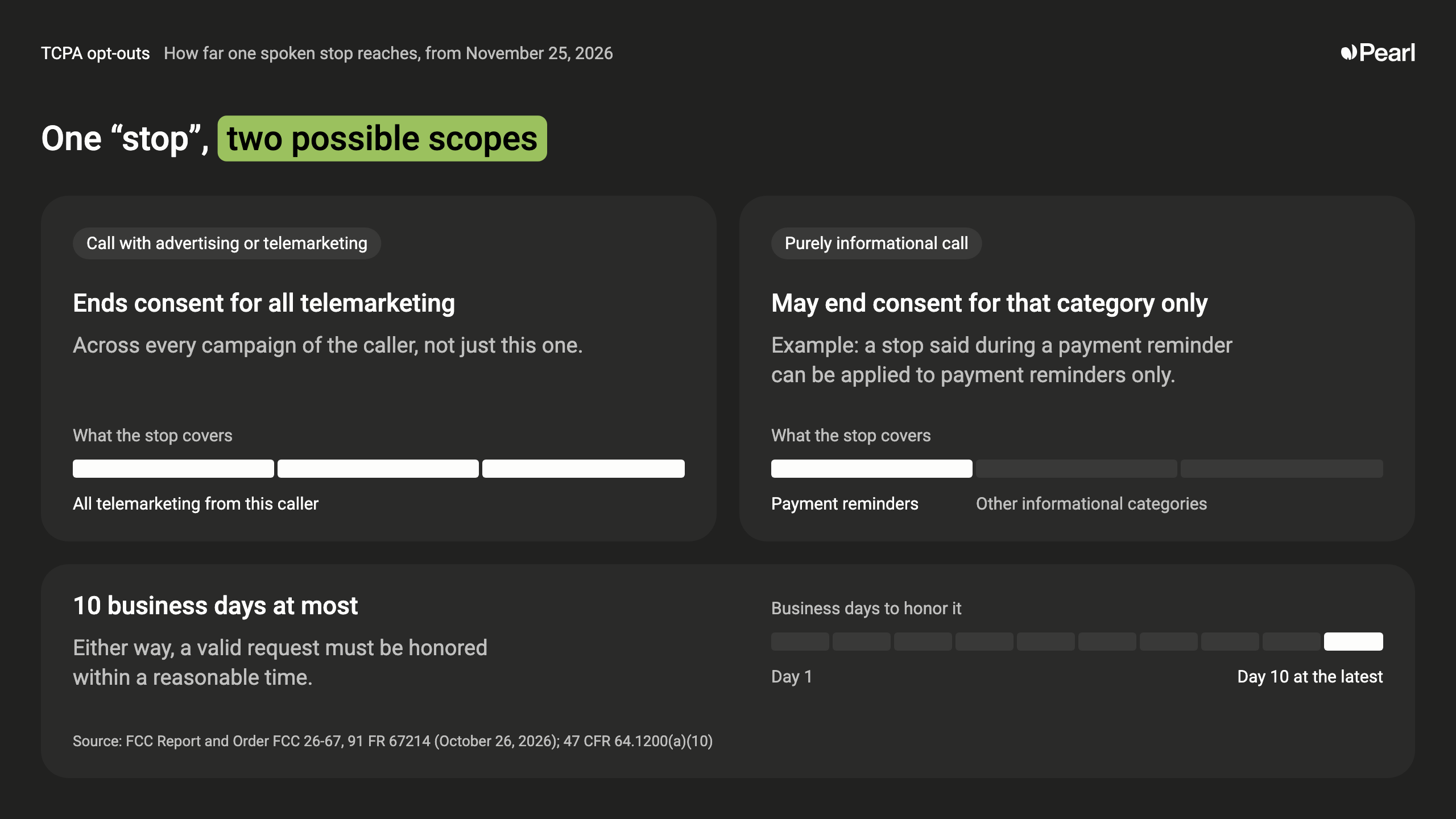
How the revised 47 CFR 64.1200(a)(10) scopes a valid revocation request. Callers that designate an exclusive opt-out method need not process requests made by other means. Source: FCC Report and Order FCC 26-67, 91 FR 67214 (October 26, 2026).
Four design decisions for AI voice agents
The rule text is written for dialers, IVR menus and SMS platforms. Applied to an agent that understands free speech, it raises questions the order does not address. What follows is our analysis of the published text, not FCC guidance, and the points marked as interpretation should be checked with counsel.
1. Free-form recognition remains necessary unless a designated method is disclosed
The exclusive-method option may tempt some teams to stop worrying about loosely phrased opt-outs. That protection exists only when a designated method is disclosed on the call. A deployment without that disclosure stays under "any reasonable means," and the rule gives no list of what qualifies. Our interpretation is that a plain spoken sentence such as "please don't ring me again," said to the agent during the call, would be hard to argue was unreasonable.
There is also an open question the order does not answer: whether a conversational agent itself qualifies as an "automated, interactive voice" opt-out mechanism. The phrase sits in rules that also cover key press menus, and we found no FCC statement applying it to conversational agents. A cautious design pairs a fixed, disclosed instruction ("say 'stop calling' or press 9 at any time") with free-form detection behind it, so the agent catches the request either way.
Recognition quality has a litigation side. One industry commenter quoted in the order argued that the "reasonable means" standard let some litigants deliberately use ambiguous phrases to evade recognition and then sue. Whatever the merits of that claim, the practical answer for an agent is to treat uncertain cases as questions: "Would you like us to stop calling you about your account reminders?" A yes gives a clean revocation with a clear scope.
2. Every call needs a category label
Category scoping is optional, and it only helps if the system knows the category. That means every campaign or call flow should carry a label (payment reminders, appointment confirmations, outage notices, marketing) that the agent and the downstream consent store both read. Without it, the safe reading of any revocation is the broadest one.
3. Sales content on an informational call changes the scope (interpretation)
The narrow scope applies only to calls with no advertising or telemarketing. An agent allowed to mention an offer at the end of a service call risks turning it, under the rule's wording, into a call that contains an advertisement. A "stop" spoken on such a call ends consent for all future telemarketing from that caller, and the rule text does not say whether the caller may still treat it as narrow for the informational category the call also served. Whether a passing offer is enough to change the call's nature is a legal question the order does not settle. Teams that let agents improvise cross-sell lines on informational campaigns should decide that question deliberately, with counsel, before the agent decides it for them.
On artificial-voice calls that do carry telemarketing, 64.1200(b)(3) adds a second constraint: once the person uses the opt-out mechanism, the number goes on the do-not-call list and the call ends immediately. Whether a free-form "stop" said to an agent triggers that provision is the same open question as above. The safer design treats it as if it does. A generative agent trained to be helpful may try to keep the conversation going ("Before you go, can I ask why?"), so opt-out handling on these calls belongs in a deterministic path: a tool call that writes the do-not-call entry and ends the call. Whether even a one-line spoken confirmation fits "immediately terminate" is a point to settle with counsel.
4. A revocation has to reach every system, with a record
The ceiling is ten business days from receipt, and the FCC is asking whether to shorten it; the joint industry and consumer letter cited in the order suggests seven. An agent that detects a revocation but writes it only to its own call log has not stopped the dialer, the SMS platform or the next campaign. The revocation should travel, with its scope, to every system that can contact the person.
The order adds no recordkeeping requirement, but records decide disputes. For a caller that has not designated an exclusive method, a consumer who produces evidence of a request made by a means not listed in the rule creates a presumption that consent was revoked, which the caller then has to rebut. A timestamped record of the request, the scope applied and the systems updated is what lets a caller answer that. Teams that already test agents against scripted scenarios can add opt-out phrasings to that suite; our guide to voice agent testing practices covers the general method.
What is still open
The Further Notice of Proposed Rulemaking attached to the order asks for comment on shortening the ten-business-day window, requiring a one-step way to revoke consent to all robocalls, requiring two-way texting, and how revocations apply across affiliates and divisions of the same company. These are proposals, and any of them could change the design above again. The federal rules also sit alongside state laws and, for callers reaching Europe, transparency duties such as Article 50 of the EU AI Act. For regulated sectors, our piece on how financial services voice agents handle compliance and security covers the wider set of obligations.
The practical test for any team running outbound AI calls in the US is short: say "stop calling me" to your own agent on each campaign type before November 25, then check which systems knew about it ten minutes later, and which category of calls actually stopped.